
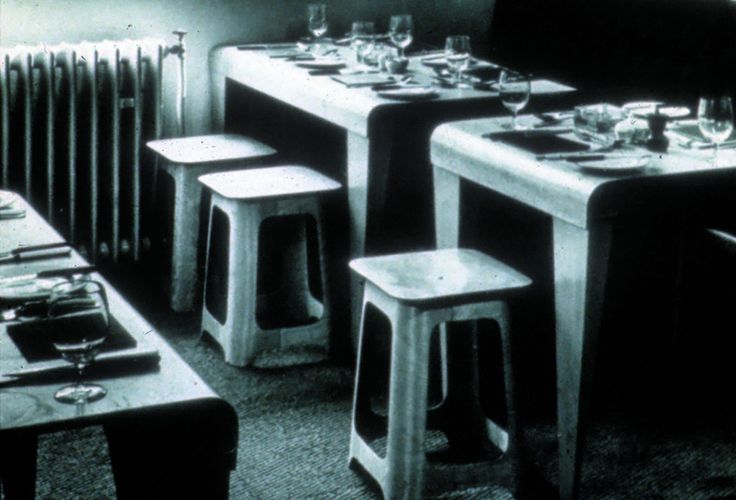
There was a time when Modernism‘s programmatic fracture with exhausted ways of building, dwelling, thinking was celebrated the world over. In architecture, official recognition started pouring in with the famous 1932 MOMA “International Style” exhibition (catalogue): honors followed on both sides of the Atlantic.
In its splendid isolation, Great Britain was initially somehow secluded from this Cambrian explosion, but not for long. In 1934 Well Coates embodied his vision of a progressive “machine for living” in the iconic IsoKon building, in Hampstead, the leafy corner of London where the intelligentsia had traditionally settled – and where indeed scores of jewish émigrés were pouring from anti semitic Germany. At various times, the building sported very distinguished residents: Gropius, Moholy-Nagy and Breuer alone conferred unmatched prestige to it. History goes that in its ground floor gathering point, aptly named ‘IsoBar’, socialites, progressives and communists of all walks of life (mostly immigrants from suicidal Mitteleuropa) weaved their ideas and held their discussions regarding the organization of an ideal society, the fate of the Soviet project and the role and function of high culture in the modern world. Modernism at its best. In its unadorned and functionalist esthetic, the building itself was a statement on the direction to embark. Previous experiments in Soviet Russia – in particular the enormously influential NarKomFin building, the archetypical “social condenser” (see also this marvellous blog) had already done the conceptual heavy lifting of negotiating the space of everyday living along communal lines. IsoKon was to prove no less ambitious – with minimal furniture, small sized kitchen and restrooms. The vision of its architect was to leverage technology in order to promote the engagement with space of its dwellers in modern and liberated directions, to engineer a structure which in its very skeleton would point to a world interested in ideas and vision, not mindless domestic chores. This was Existenzminimum, this was Bauhaus, this was the human use of human being. We are still waiting for this to happen – for this vision to materialize in the society at large.

 rtraba
Leave a reply to pulcinapulciosa Cancel reply